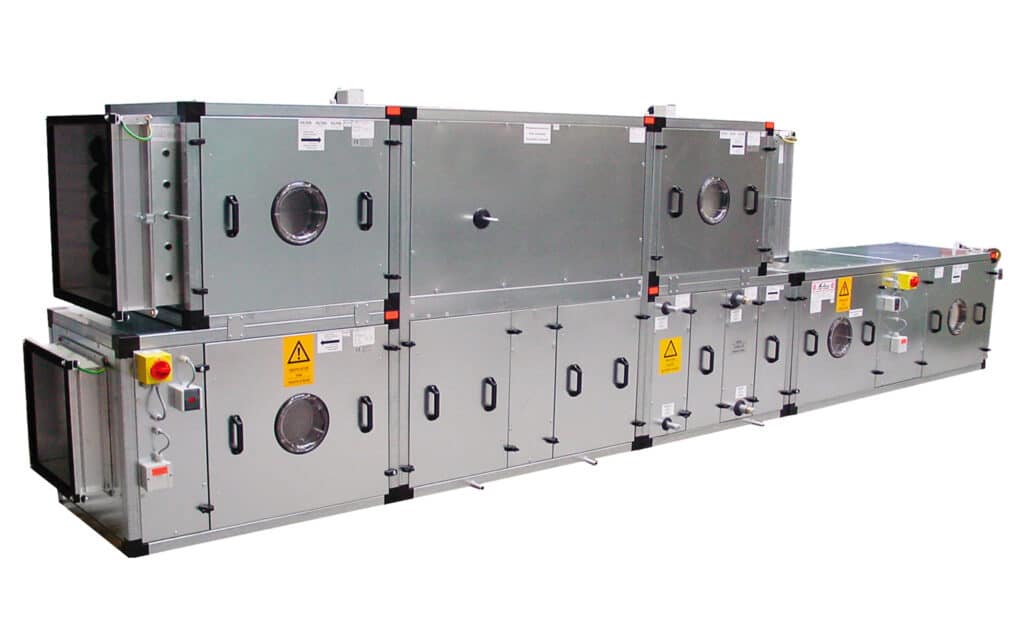
AHU
Experience optimal airflow and temperature control with our high-performance Air Handling Units (AHUs). Each system is engineered with quality HVAC parts to ensure superior air distribution, energy efficiency, and long-lasting reliability
Energy Efficient Modern Fans and Their Advantages
In most cases, modern fans and motors are directly interchangeable with their predecessors, allowing for simple replacements with minimal disruption. Any voltage combination can be accommodated i.e. DC or AC single- or three-phase, as the electronics can be fully integrated into the motor or accommodated by controls systems modifications when carried out by trained and experienced engineers.
EC fans offer enhanced control and provide the most simple, but effective solution for reducing AHU energy consumption. EC fans today are focused on maximum energy-efficiency to enable equipment used in ventilation to work as economically as possible, setting new standards with regards to reliability, service life and energy consumption.
EC fans are fully compatible with most units, meaning that straight-forward, cost-effective EC fan upgrades can be carried out with minimal disruption.
- Up to 70% potential energy saving
- Variable speed control matched to load
- Direct drive motors for maintenance free operation
- 50% more efficient than previous generation fans
Factors to Consider When Selecting the Right Fan
There are many contributing factors to consider when selecting the ‘right’ fan for an application. The operating point is the first thing to identify. This is the target airflow rate in cubic feet per minute and the system resistance (or impedance) in inches of water. The target flow rate is usually a known value. The system resistance or impedance is not always available. Knowing the operating point is essential in selecting the correct fan.
That said, selecting a fan solely on the basis of its operating point may not yield the best results. The path the air must take through the system must also be factored into fan selection. The impact that the air flow path has on a fan’s selection can be dramatic – it can make a very efficient fan perform very poorly and so to select the optimum fan, it is crucial that a full survey is undertaken by an experienced and qualified engineer to identify the above and also understand what the organisation’s design goals are. Whilst the operating point defines the most important variable, power consumption and dependent on application, noise reduction is a huge driver. When noise is a critical factor, the best solution is typically a larger fan running at the lowest possible speed.
Space constraints can also be a factor, and as such, the selection of the right fan must consider the available space within the application. The most efficient or quietest fan may not fit within the available physical space.
Fan selection can never be viewed as a one-size-fits-all approach. It’s really a compromise between variables. The key to finding the right fan is to identify the model that results in the fewest compromises.
As a starting point, it is important to make a site survey of the existing kit. This can help give the organisation a good idea of payback periods and on-going savings if fan upgrades are undertaken. It is a good idea to work with a supplier with specialist knowledge in this area, as they can help identify design goals.
Hiring an experienced supplier and installation team is crucial when starting a fan upgrade project to ensure the solution is tailored to the business’s needs.

The Growing Need for Energy-Efficient HVAC Solutions
The HVAC industry is now under intense scrutiny due to environmental concerns and global warming. With the Eco-design Directive enforcing energy efficiency, manufacturers are rethinking production to reduce carbon footprints.
Since HVAC systems can consume over 40% of a commercial building’s energy, businesses are under both social and legal pressure to improve efficiency. However, many companies can’t afford full unit replacements.
Fortunately, upgrading AC fans to modern EC fans can significantly enhance performance — reducing energy usage by up to 70%. Modern fan technology, combined with the natural degradation of older units, makes retrofitting one of the simplest and most cost-effective energy-saving measures.
Smart Fan Upgrades for Long-Term Savings
Upgrading fans offers a substantial financial payback for minimal investment compared to full replacements. Even though older systems aren’t legally required to meet new efficiency standards, partial upgrades help contribute to a greener planet.
Rather than focusing only on initial cost, it’s important to consider lifecycle and operational energy savings. Energy consumption can be reduced through several upgrade options:
Replacing motors with high-efficiency AC models for up to 20% savings.
Upgrading older forward curved fans with backward curved or aerofoil blades.
Switching from belt-driven to direct drive fans — cutting maintenance costs by up to 80%.
By adding variable-speed AC motors, PM motors, or EC fans, buildings can save between 30% to 60% on annual electricity costs.