


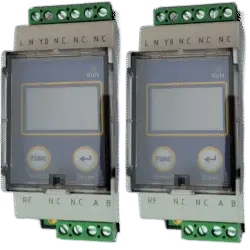
LoRa Wireless RS485 transmitter or receiver with LCD screen – 1 Unit
Original price was: £150.00.£80.00Current price is: £80.00. Exc. VAT
LoRa Wireless RS485 transmitter or receiver with LCD screen – 1 Unit
⚡ Electrical Calculator
🔌 Cable Size Reference
🌬 Unit Converter
🔋 Transformer VA & MCB Calculator
📊 Reference Guide
| Current (A) | Cable Size (mm²) |
|---|---|
| 6 | 1 |
| 6-12 | 1.5 |
| 12-25 | 2.5 |
| 25-32 | 4 |
| 32-40 | 6 |
| 40-64 | 10 |
| You must consider Ambient Temperature, Location and Thermal insulation in contact with cable. | |
Description
The LoRaWAN Data Transmission Terminal is a universal communication terminal built around a LoRa RF chip.
It integrates two industrial-standard RS485 interfaces and supports multiple protocols, enabling data transmission between wired and wireless devices.
Works with solar systems like GivEnergy, FOX Solis inverter and others; please see our blog/post on this: Solar inverters with Modbus RTU communication to battery systems
It supports the LoRaWAN Class C protocol. It is widely used in IoT, centralised metering, and industrial control, among other areas.
LoRa data transmission terminals are universal communication interface equipment.
Enables wireless RS485 data transmission, eliminating the need for long cables in complex installations.
Includes a pair of communicators (transmitter and receiver).
Note: If more than one LoRa transmitter/receiver set is used on site, they must operate on different communication channels.
IMPORTANT: ALWAYS CONNECT THE ANTENNA BEFORE POWERING UP THE TRANSMITTER OR RECEIVER
Key features:
- Small, easy to install
- Operating temperature range: -20 to 70 oC
- 1 standard RS485 interface, supporting a variety of protocols and communicating with various automatic devices with RS485 interfaces
- Equipped with LoRa chips SX1276 from Semtech for the RF part
- Supports the LoRaWAN Class C protocol
- Band: 433 MHz
- Wireless ultra-long transmission range with up to 6-8 km barrier-free
- 1.9-meter Antenna lead with magnetic base, antenna 413-453 MHZ
- Display interface: 128×64 lattice OLED, which can query power parameters on site
- Switching function: 1 way 5A relay switch output, L to Y0
Mostly used in metering projects where cabling is expensive or not possible. This module integrates remote Modbus meters and I/O modules without long cable runs.<
Communication
- Interface RS485 half-duplex
- Protocols: MODBUS RTU, DL/T 645
- Baud rate: 1200, 2400, 4800 or 9600 bps, 8N1, 8E1 or 8O1
- Packet Length Sent: 255 bytes
- Packet Length Received: 255 bytes
System Modes
- LoRa Radio – Long Range Radio, and is mainly targeted for M2M and IoT networks. This technology enables public or multi-tenant networks to connect multiple applications on the same network.
- LoRa PMAC – Basic LoRa connection example, sending and receiving data. In LoRa–MAC mode, the LoRaWAN layer is bypassed, and the radio is used directly.
- LoRaWAN – A low-power, wide-area networking protocol built on the LoRa radio modulation technique.
Power supply
- 220V/230Vac ±20% 45-65Hz
- Power Consumption <1W
Housing
- Dimensions: 90 mm long x 60 mm deep x 37 mm wide.
- Construction: plastic, self-extinguishing (PC/ABS)
- DIN rail mounting (DIN EN 50022 norm)
- Cooling: internal air circulation
Environments
- Operating temperature: -25°C to 55°C
- Storage temperature: -40°C to 85°C
- Relative humidity: 5 to 95%, no condensation, no frost
- Ingress Protection Rating: IP40 – for indoor installation
Technical Parameters
- Working Frequency Range: 433 MHz
- ISM Band: 433 MHz
- Antenna Impedance: 50 Ohms
- Output Power: 18 dBm, 100 mA
- Sensitivity: -139 dBm
- Sending Packet Length: 255 bytes
- Receiving Packet Length: 255 bytes
- Communication Range: 6-8 km
Documentation & Downloads

Software to Download: OBM_LoRa_223
USB-RS485 Driver Software to Download
Modbus_Serial_Scan Software to Download


Additional information
| Amps | 4A, 6A, 8A |
|---|
Related products
-
GivEnergy
OB115-MOD Meter with Split CT works with GivEnergy System- Modbus RTU – ID2 Address
£68.00 Exc. VAT Add to basket -
Current Bar/Power Bar EB
LoRa Wireless RS485 transmitter and receiver with LCD screen – 2 Units
Original price was: £260.00.£160.00Current price is: £160.00. Exc. VAT Add to basket -
-
LoRaWAN Devices
Multitech Cellular Gateway – Conduit® LoRAWAN Gateways with BACnet
£378.00 Exc. VAT Add to basket



Recently Viewed Products
-
Immersion Sensor
Stainless Steel Immersion Pocket
Price range: £20.89 through £27.00 Exc. VAT Select options This product has multiple variants. The options may be chosen on the product page

