
HVAC Products & Smart BMS Controls | Commercial Solutions
HVAC Products & Smart BMS Controls | Commercial Solutions
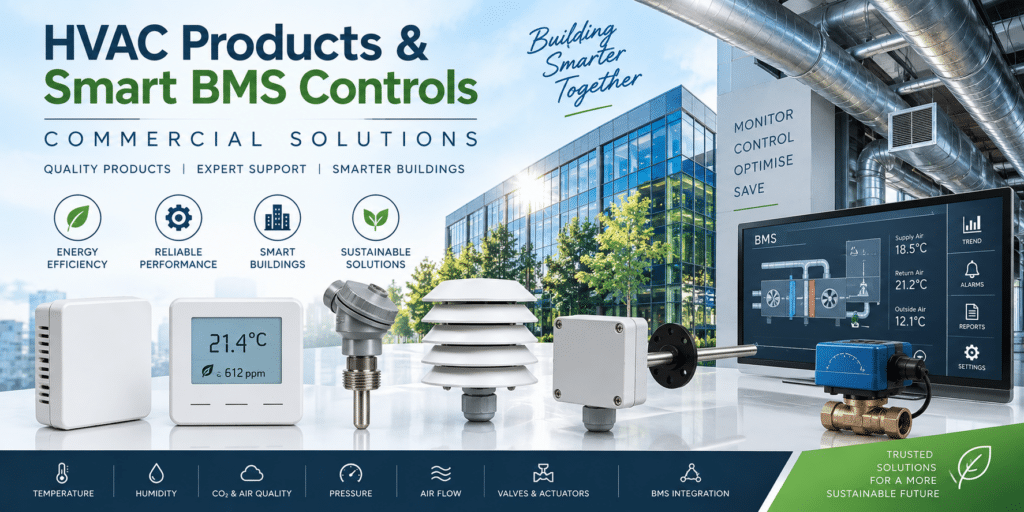
The Evolution of Commercial HVAC Products
The landscape of commercial climate control has undergone a massive transformation. Historically, heating, ventilation, and air conditioning systems operated on basic, analog schedules. Today, modern HVAC products function as the intelligent central nervous system of commercial properties. Driven by the urgent need for global decarbonisation and rising energy costs, today’s hardware is designed to communicate, adapt, and self-optimise in real time.
At the heart of this evolution is the integration of physical hardware with digital building management systems (BMS). Instead of running boilers and chillers on rigid, pre-set timelines, modern infrastructure utilises live data to balance comfort and consumption. By deploying smart, interconnected components, facility managers can target heating and cooling precisely when and where it is needed, drastically reducing waste without compromising occupant comfort.
Upgrading to intelligent HVAC products is no longer just an operational preference; it is a foundational requirement for any commercial facility aiming to remain competitive, compliant, and energy-efficient in a net-zero world.
Smart Thermostats and Environmental Sensors
To make intelligent decisions, a climate control system requires precise, real-time data. This is where advanced environmental sensors and smart thermostats play a critical role. Gone are the days of simple wall-mounted thermometers that only measure ambient temperature. Modern sensor arrays monitor a wide range of variables, including relative humidity, carbon dioxide (CO2) levels, volatile organic compounds (VOCs), and occupancy density.
By continuously tracking these data points, smart thermostats can dynamically adjust ventilation rates and temperature zones. For example, during a high-occupancy meeting, sensors detect rising CO2 levels and signal the ventilation system to increase fresh air intake. Once the room empties, the system automatically scales back, conserving energy. This responsive approach ensures optimal indoor air quality while preventing unnecessary heating or cooling of unoccupied spaces.
Control Valves, Actuators, and Flow Dynamics
While sensors and controllers act as the brain, control valves and actuators serve as the muscles of any commercial hydronic system. Achieving precise temperature control requires absolute mastery over water flow dynamics. This is where pressure-independent control valves (PICVs) have revolutionized the industry. Unlike traditional valves, which can suffer from fluctuating system pressures, PICVs maintain a constant flow rate regardless of pressure changes within the piping network.
When paired with high-precision electronic actuators, these valves respond instantly to control signals from the BMS. This synergy prevents common system inefficiencies, such as overflow and thermal hunting, where valves constantly swing open and closed trying to find the correct balance. By stabilising flow dynamics, actuators and valves protect expensive chillers and boilers from premature wear while ensuring consistent thermal delivery throughout the entire facility.
Key Benefits of Upgrading Your HVAC Infrastructure
Investing in high-performance HVAC products delivers immediate, tangible advantages that extend far beyond simple temperature regulation. For building owners and operators, upgrading legacy mechanical systems is one of the most reliable methods to improve the bottom line while enhancing asset value.
- Substantial Utility Savings: High-efficiency components, such as variable speed drives and smart valves, directly lower electricity and fuel consumption.
- Enhanced Occupant Well-being: Precise control over ventilation and temperature significantly improves indoor air quality, boosting productivity and comfort.
- Reduced Maintenance Costs: Modern, self-diagnostic hardware alerts maintenance teams to minor performance anomalies before they escalate into costly system failures.
- Extended Equipment Lifespan: Balanced flow dynamics and automated scheduling reduce mechanical stress on central plant equipment.
Maximizing Energy Efficiency and Cost Savings
Energy consumption in commercial buildings is heavily dominated by heating and cooling processes. By retrofitting outdated systems with energy-efficient HVAC products, facilities can unlock rapid cost savings. For instance, installing variable speed drives (VSDs) on pumps and fans allows them to run at partial capacity during off-peak hours rather than running at 100% capacity constantly. Because motor power consumption has a cubic relationship with speed, even a minor reduction in fan speed can lead to massive drops in energy use, resulting in an incredibly fast return on investment.
Regulatory Compliance and Net-Zero Goals
Governments worldwide are continuously tightening building energy performance standards. To avoid costly non-compliance penalties and future-proof assets against depreciation, building operators must align their facilities with net-zero targets. Implementing smart building automation systems and high-efficiency peripherals is the most practical way to meet these strict environmental mandates. Furthermore, these upgrades contribute vital points toward prestigious green building certifications, such as LEED and BREEAM, which significantly boosts the market value and tenant appeal of commercial real estate.
Selecting the Right HVAC Products for Your Project
Choosing the ideal components for a commercial facility requires a strategic approach that balances immediate project costs with long-term operational efficiency. No two buildings are identical, meaning hardware must be carefully matched to the unique architectural and operational profile of the property.
| Product Category | Primary Function | Key Selection Metric |
|---|---|---|
| Smart Sensors | Environmental data collection | Accuracy, multi-variable tracking, wireless range |
| Control Valves (PICVs) | Hydronic flow stabilization | Flow rate capacity, pressure range, material durability |
| Variable Speed Drives | Motor speed optimization | Voltage compatibility, harmonic distortion levels |
| BMS Controllers | Centralized system logic | Protocol compatibility (BACnet/Modbus), input/output capacity |
Compatibility is a critical consideration during any retrofit. When introducing new digital controls to a legacy system, ensure that all components communicate seamlessly using open-standard protocols such as BACnet or Modbus. Choosing open-protocol hardware prevents vendor lock-in, allowing you to easily scale, modify, and upgrade your building management network as your operational needs evolve over time.
Finally, always partner with a reputable distributor that provides comprehensive technical support. Having access to expert guidance during the selection, installation, and commissioning phases ensures that your new hardware is configured for maximum efficiency and long-term reliability from day one.
Take Control of Your Building’s Efficiency Today
Ready to optimize your facility’s climate control, reduce energy waste, and lower your carbon footprint? Explore our extensive catalog of professional-grade HVAC products, including smart sensors, high-precision control valves, and advanced building automation controllers. Contact our dedicated engineering support team today to receive a tailored technical recommendation or a rapid quote for your next project.